
For 20–35 pupils, divide the class into crews of 2–6 and prepare one complete Player Pack per crew. In Paper Adventure’s free Celebration Classroom game, pupils rebuild an invitation, share four badge clues and make a display badge that another crew reviews.
1. Plan crews before printing
The Adventure Club’s First Badge supports up to 35 pupils in separate crews. The examples below keep each crew within the 2–6 pupil range; other balanced arrangements within that range also work.
| Pupils | Example crews | Player sheets |
|---|---|---|
| 20 | 4 crews of 5 | 36 |
| 24 | 4 crews of 6 | 36 |
| 30 | 5 crews of 6 | 45 |
| 35 | 5 crews of 6 + 1 crew of 5 | 54 |
For example, 24 pupils could also work in six crews of four, which needs 54 Player sheets. Choose the crew size for your space and pupils, then multiply nine pages by the number of crews.
● ● ●1 complete Player Pack
● ● ●1 complete Player Pack
● ● ●1 complete Player Pack
● ● ●1 complete Player Pack
Setup illustration: one possible arrangement for 24 pupils, not a required seating plan.
2. Give each crew a complete paper set
The Player Pack has nine pages per crew. The separate nine-page Teacher Guide can be read on screen or printed once for the teacher. If printing the guide, add nine sheets to the table totals. Download both PDFs in the same paper size and print single-sided at Actual size / 100%.
Keep each crew’s invitation, welcome-table materials, four badge clues, blueprint, symbols, display badge and review sheet together. Prepare the cuts before play, then keep the next mission’s pieces with you until the current result is checked. Paper and pencils support the activity; the badge stays flat or folds into a table tent, with no pin or glue needed.
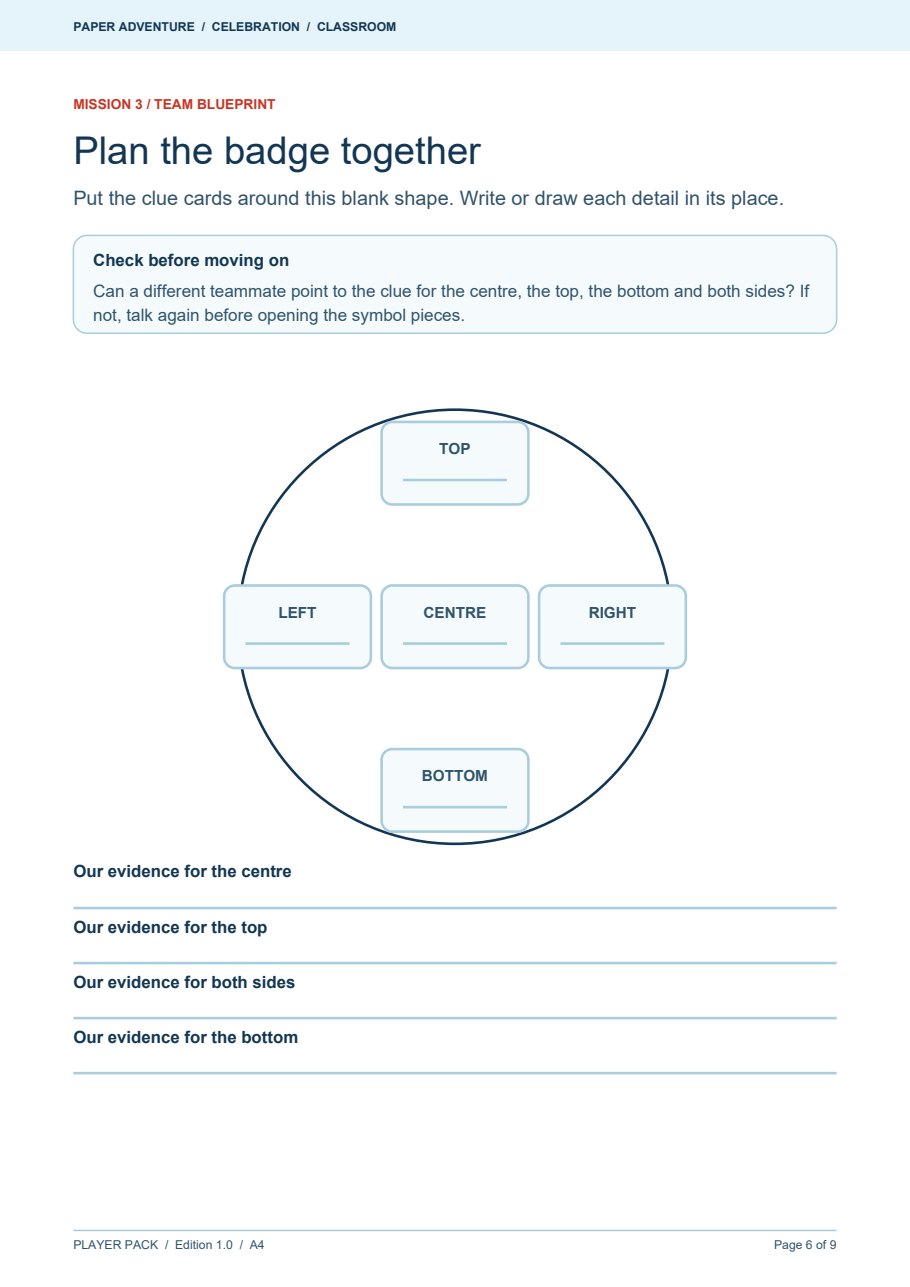
3. Separate the four jobs from the four clues
- Story Reader
- Reads the steps and invites ideas.
- Prop Mover
- Moves the pieces after the crew agrees.
- Team Recorder
- Writes or draws the shared plan and results.
- Evidence Checker
- Points to the printed clue behind a decision.
Rotate jobs after each mission. Two or three pupils can combine jobs; in crews of five or six, partners share Reading or Moving and each contributes before rotating.
The four badge clue cards are information to share, separate from these job titles. Deal the clues separately and ask holders to explain what they know. The crew checks each proposed badge feature against a clue before putting it on the blueprint.
4. Run the five missions, then review together
- Rebuild the invitation. Read the opening scene and let crews join its scattered pieces.
- Set the welcome table. Use the invitation to place the printed supplies on the mat.
- Pool the badge clues. Compare all four clues and record one plan on the blank blueprint.
- Make the badge. Try the symbols, check against the evidence, then draw or write the design.
- Welcome and review. Pass the badge and all four clue cards to the next crew in a circle. Use the review sheet and return mismatches for a friendly repair.
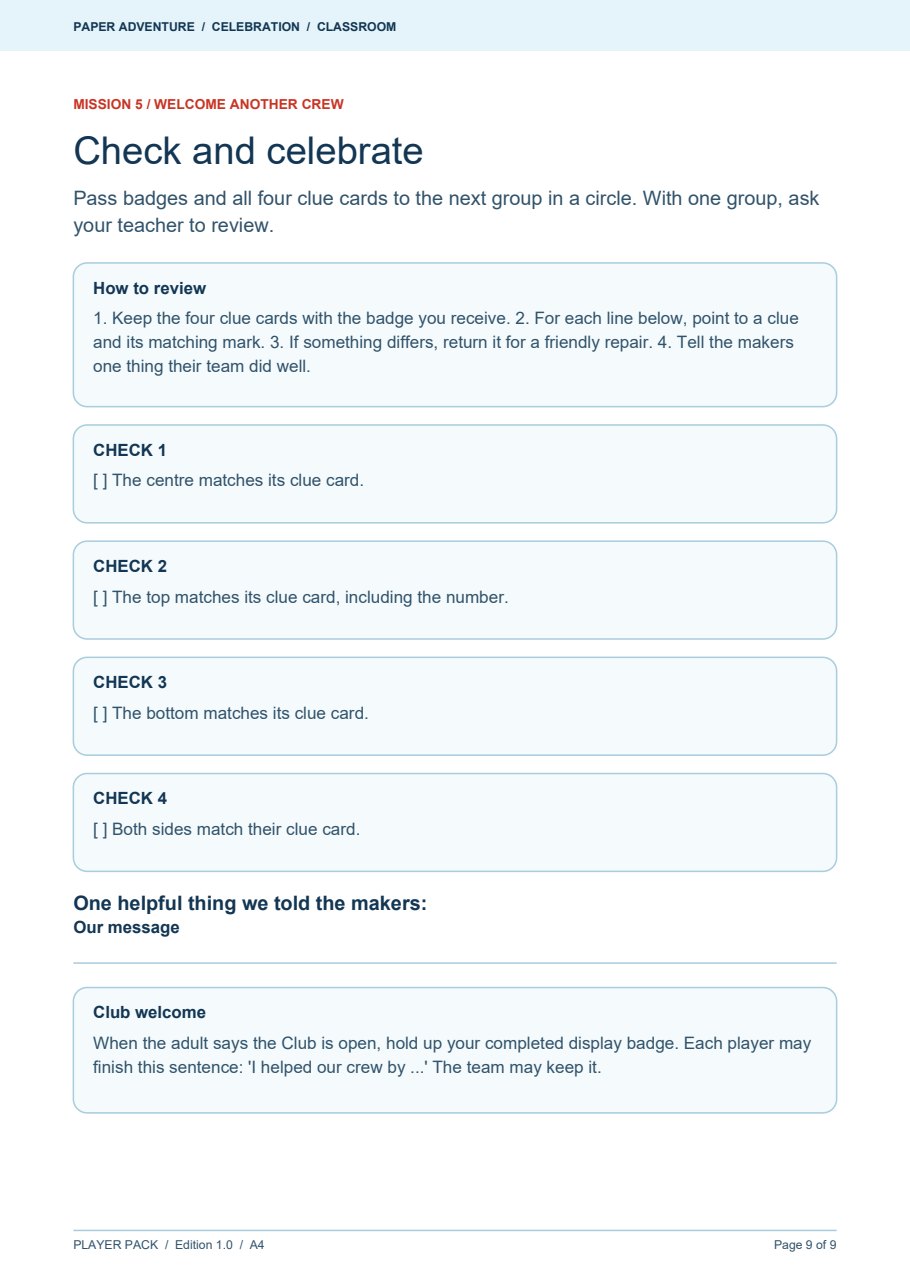
With only one crew, the teacher reviews. Finish by inviting each pupil to say or show how they helped. Read the Teacher Guide before the session for the full handoffs, hints and answers; this article is a planning aid, not a replacement.
How do I keep different crews moving?
Keep each crew’s materials and decisions separate. A fast finish is a chance to check the reasoning, not permission to reveal another crew’s next task.
| What happens | What the adult can do |
|---|---|
| One crew finishes before the others | Ask it to explain how each badge condition is met and prepare its evidence for the next review. Do not let it announce an answer to another crew. |
| Several crews ask for help at once | Ask each crew to mark the condition it cannot explain. Visit one crew at a time and use the matching Teacher Guide hint, keeping later missions with the teacher. |
| A review crew disagrees with a badge | Return to the four clue conditions and inspect each one. Ask for a reason for the disputed feature, then revise and review the badge again. |
Worked planning example: 24 pupils
- Choose four crews of six and label their materials A–D before cutting. The four nine-page Player Packs require 36 single-sided sheets.
- Keep one nine-page Teacher Guide with the teacher. Reading it on screen keeps this example at 36 printed sheets; printing it once makes 45.
- Deal only the current mission. When a crew is ready, ask it to explain its result before releasing the next mission’s materials.
- At the badge review, pass the badge and the conditions to another crew. The reviewers check the conditions, then return a specific explanation of anything to change.
The pupil groups and print totals above are planning examples for the free Celebration Classroom edition. They are not attendance data or measured completion times.
Materials behind this guide
- Celebration Classroom Player Pack and Teacher Guide — the matching free materials in A4 and US Letter. Use the current adult guide for task-by-task instructions and answers.
- Printing and preparation help — paper size, single-sided printing and separating player pages from adult answers.
These are instructions for Paper Adventure’s own materials, not evidence of a learning outcome. Tell us if a page or instruction does not match your files.
Open the complete free Classroom game
Choose A4 or US Letter and download the Player Pack with its separate Teacher Guide.
Get the free game Explore more Classroom storiesPlan your next session
How to Run a Printable Adventure for 2–6 Kids
A practical host checklist, from the first print to the final parcel.
Read the guide
How to Host a Printable Birthday Adventure for Kids
Pick a story, set up the table and keep every child involved.
Read the guide